
The program began with a familiar enterprise assumption, if store communications were not landing, the answer was probably 'better task management.' The research showed something more important. I led stakeholder interviews, site visits, and field interviews to understand how information actually moved from corporate to stores, where it broke down, and why existing tools were not creating real engagement at the store and hourly-colleague level.

The challenge
The system was biased toward pushing actions, not helping people absorb meaning, context, and relevance.
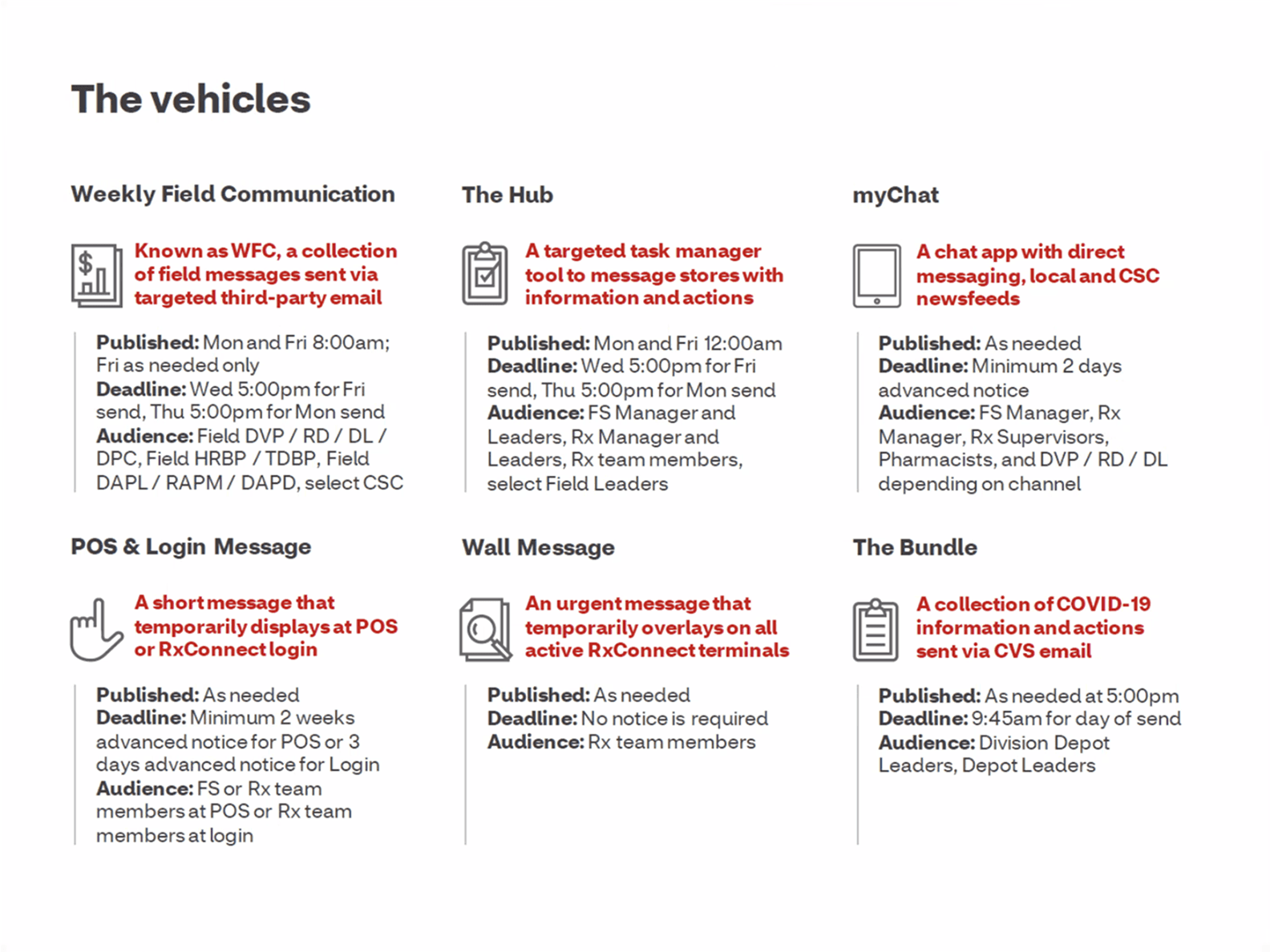
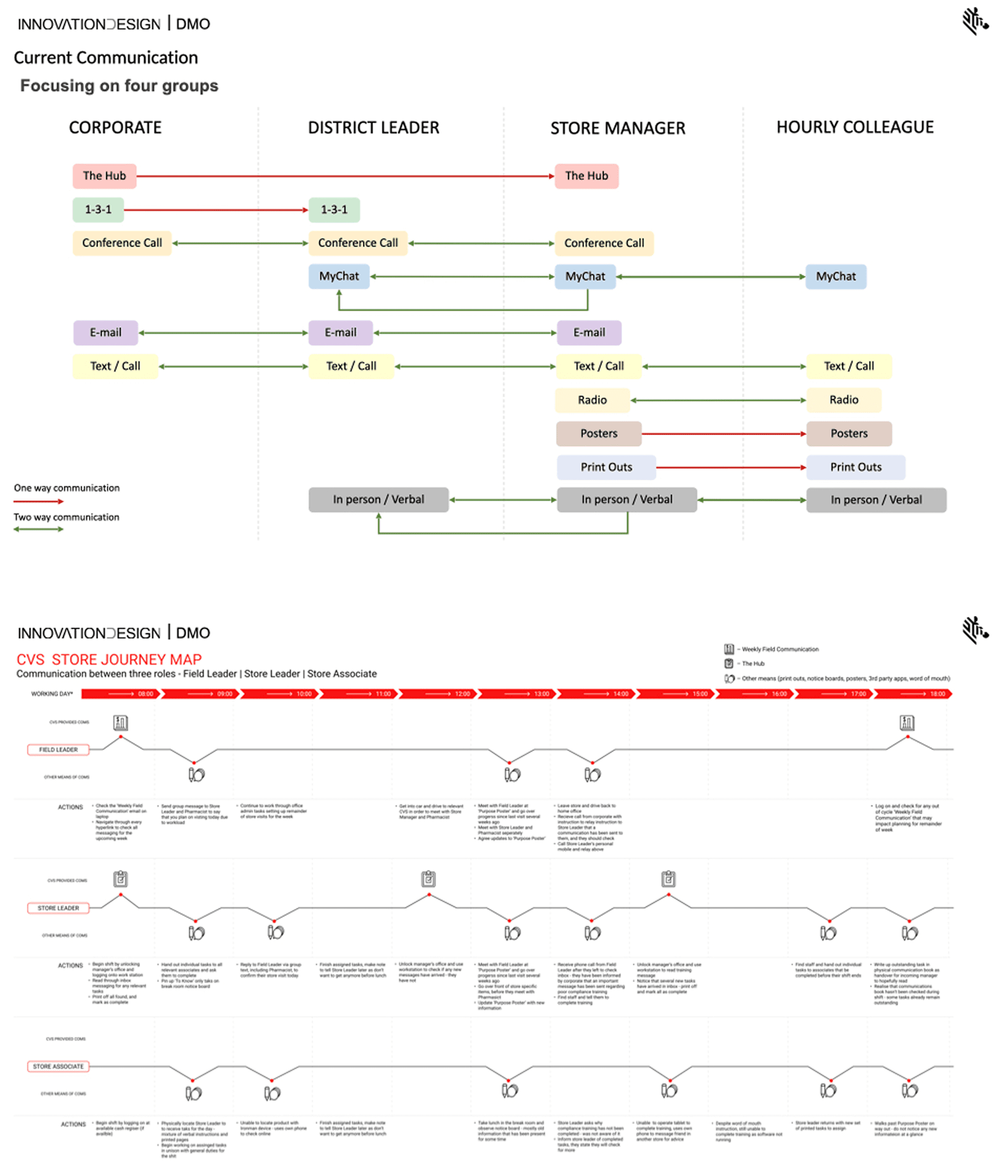
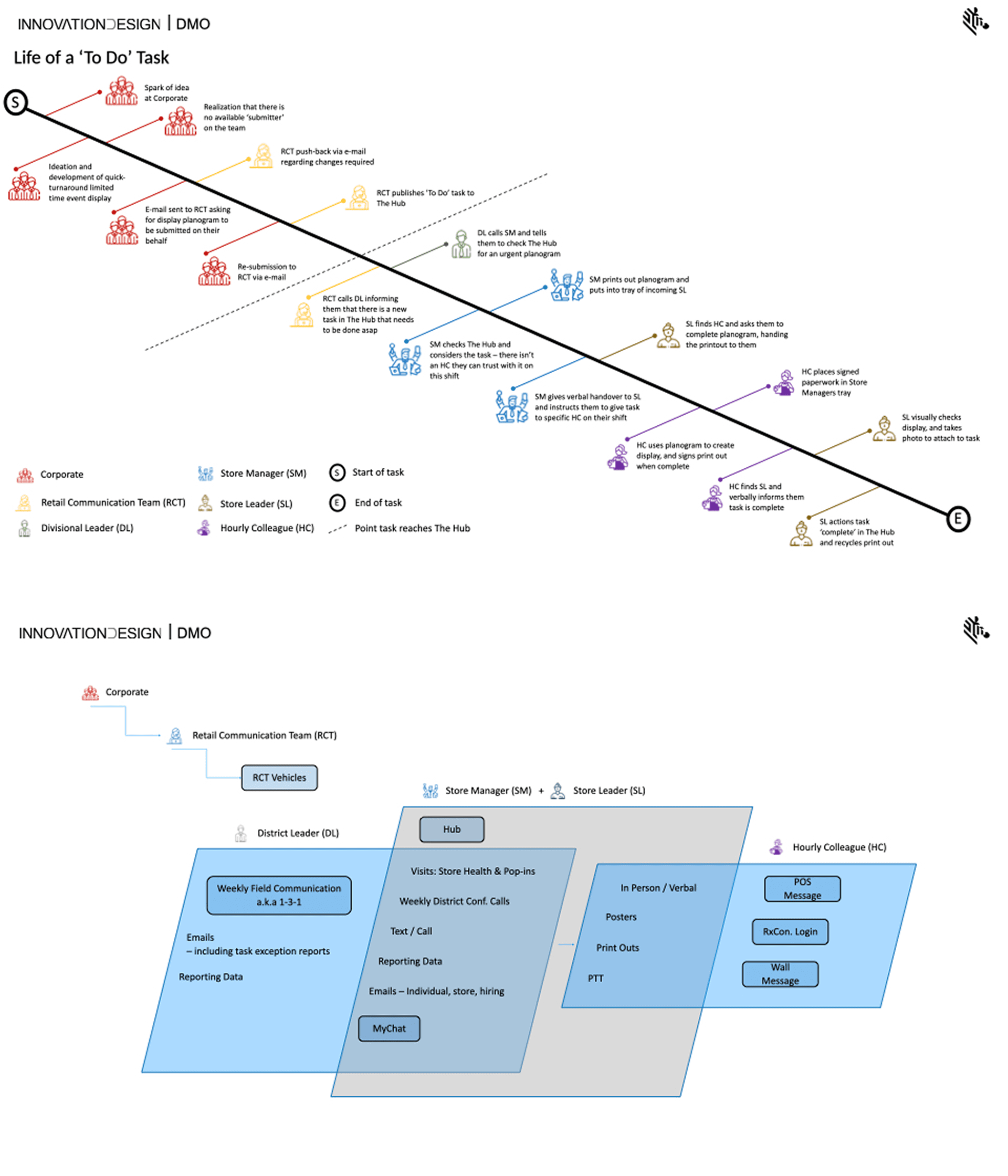
The existing communication flow involved a crowded ecosystem: email, reporting data, district visits, calls, posters, printouts, verbal follow-up, PTT, a dedicated hub, 3rd party messaging, POS messages, and RX device login messages.
That meant messages were often fragmented across platforms, levels, and devices before they ever reached the people expected to act. Site and stakeholder work made a key distinction clearer, “to do” tasks communicated actions to be taken in defined time ranges, while “to know” content communicated the broader why, context, and resources needed to take the right action.
Leaders were relatively confident that task engagement existed, but much less confident that the 'why' was making it down to store and hourly colleague level. The challenge was not just to improve task completion, but to create better engagement with the communication platform itself.
My approach
Map communication as a real system, not a software feature.
I structured the work in three layers: stakeholder interviews to understand the future perfect aspirations and systemic assumptions, field visits to observe what people actually did in store environments, and synthesis around the lifecycle of a task from corporate through district and store leadership to hourly colleagues. That made it possible to separate the official communication model from the real one. Instead of treating the Hub as a self-contained platform, I looked at the wider behaviors around it: where workstations were locked away, which tools were only accessible at certain levels, where mobile devices were and were not available, how often users had a reason to check in, and what workarounds existed when formal tools failed.
That structure surfaced four concrete problem areas:
Access was too limited: some tools were mostly available on workstations, sometimes in locked rooms, and some audiences simply could not reach the system easily from the floor.
Frequent engagement was weak because there were not enough reasons or mechanisms to return, especially without meaningful notifications and audience filtering.
Seamless usage was poor: users had to look in too many places to get a complete picture, workflows required too many clicks, infrastructure and hardware quality were inconsistent, and even basic actions like finding completed tasks could become frustrating enough to avoid serious use.
Adoption was capped because tasks were “trapped objects” with too little connection to follow-up actions like delegation, comment, proof of work, or recognition.
The impact
The work reframed the product from a task-completion tool into a communication engagement problem, which produced much clearer design direction.
The recommendations followed directly from that shift. Expand access by making the Hub available to more people and more usable on mobile devices. Promote frequency of engagement through push notifications, audience filtering, concise copy, and stronger visual prioritization. Enable quick and fluid use by improving hardware and infrastructure, consolidating and connecting systems, improving UI recognition, and streamlining clicks, navigation, search, and bookmarking. Increase feature adoption by building bridges to next actions such as delegation, comment, recognition, proof of work, printing, metrics, and scheduling. The most important outcome was strategic: stop measuring success only through item completion, and instead design the platform around meaningful audience engagement.