
Emergency response is only as reliable as its weakest link.
In safety-critical environments, false alarms and missed alarms both cost lives. Across healthcare and public safety, devices increasingly include duress functionality, physical panic buttons, digital triggers, drop detection, and PTT escalation. However, no unified strategy existed across verticals. Product teams were building features in isolation. Hardware, software, and case design decisions were not being evaluated systemically. I was tasked with defining the opportunity space across healthcare and law enforcement, and determining whether our current approach actually protected users.
The challenge
We were shipping a red panic button . . . Then covering it with a blue case.
In healthcare ride-alongs, including home health environments, I observed that the red duress button, intentionally colored for visibility, was completely obscured by a protective case. The visual affordance was removed. The tactile experience was unchanged from other buttons. When held in strap orientation, activation required an awkward multi-step motion.
Worse:
The button required similar actuation force to standard controls.
Accidental presses risked creating “cry wolf” desensitization.
In the most dangerous moments, the tablet was often placed out of reach.
We had created a theoretical safety feature that, in practice, could fail under pressure.
In law enforcement interviews across the UK (MPS), US municipal departments, and advisory board members, officer safety was consistently described as the number one priority. 79,091 officers were assaulted in 2023 — a 10-year high. Emergency activation reliability is not optional.
My approach
I defined the cross-vertical duress strategy and surfaced critical design risk.
My approach included leading all efforts in:
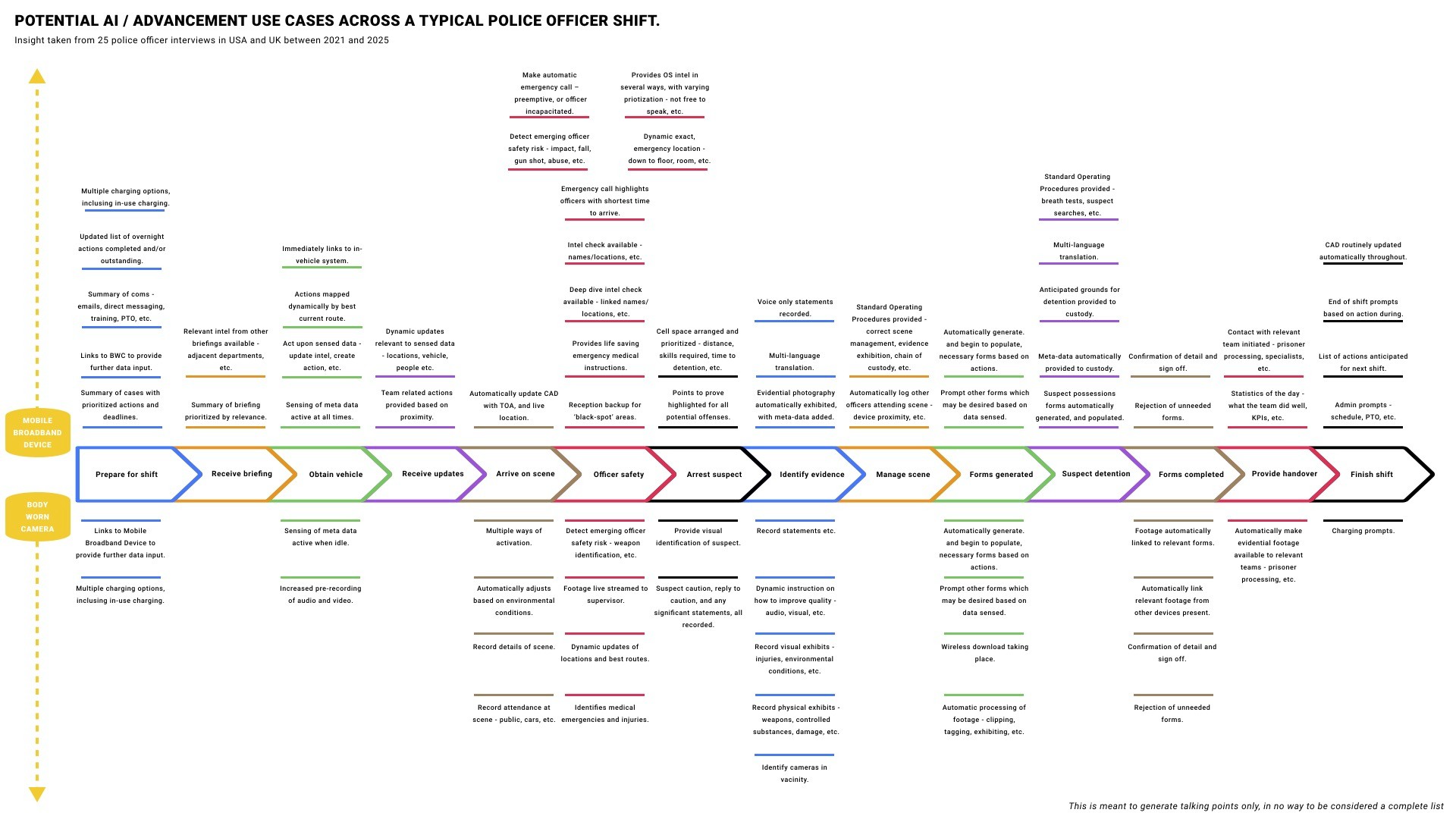
Field ride-alongs in healthcare and law enforcement
Cross-role interviews (patrol, detectives, mounted branch, supervisors)
US and UK stakeholder interviews
Advisory board workshop at IACP
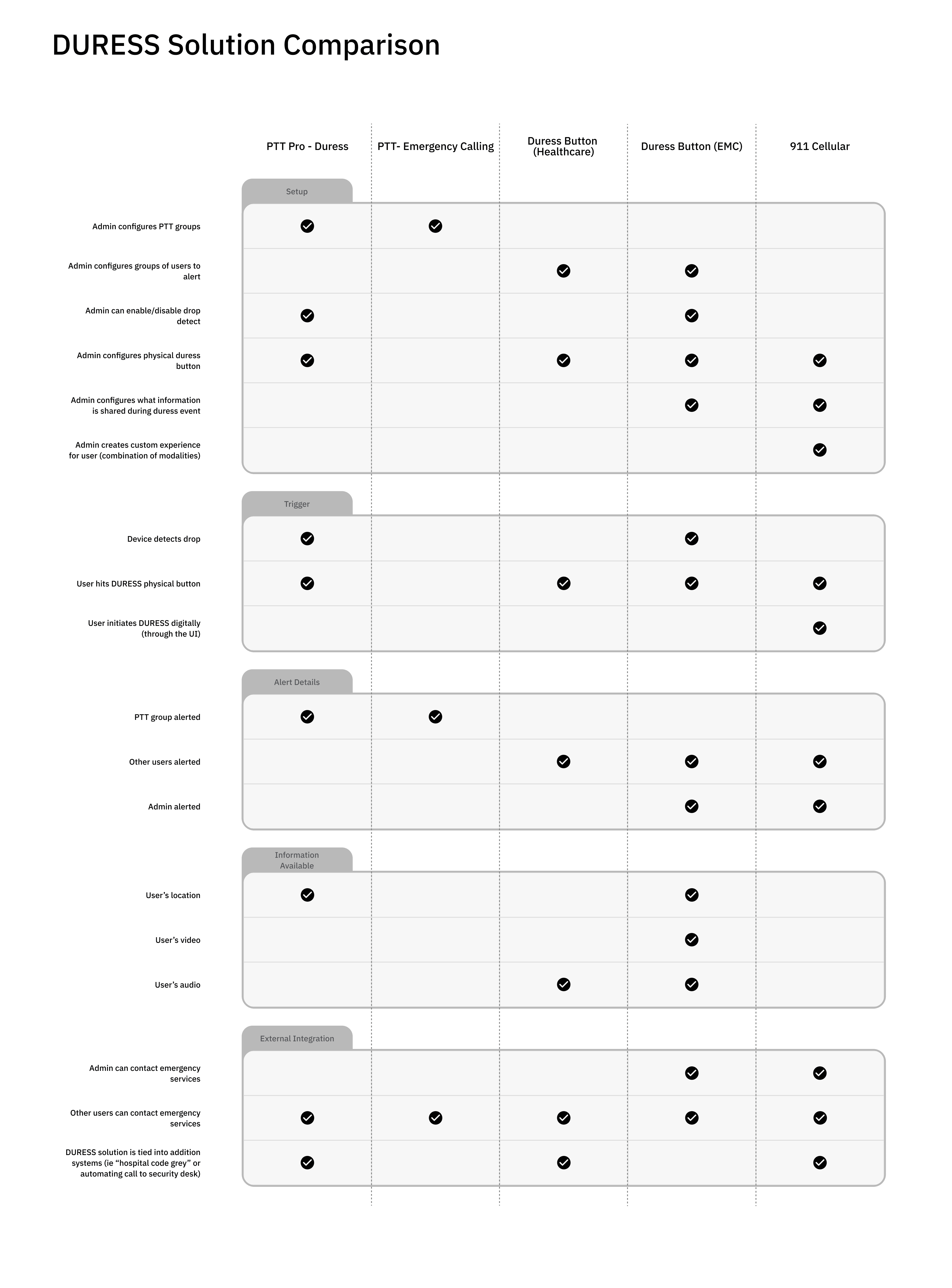
Comparative solution analysis across PTT, healthcare duress, EMC, and 911
Hardware + case + modality evaluation
I synthesized findings into a structured Duress Solution Comparison framework, evaluating setup, trigger methods, alert routing, information availability, and emergency integration across five models.
The outcome was not incremental improvement, it was strategic reframing.
I structured the work across three layers:
Field Immersion
Ride-alongs in home health and police patrol to observe how devices are actually held, docked, stored, and accessed during volatile interactions.Cross-Role Interviews
Officers from ERPT, detectives, public order units, mounted branch, and US patrol teams highlighted differences in radio reliance, battery constraints, signal dead zones, and device dependency.System Mapping
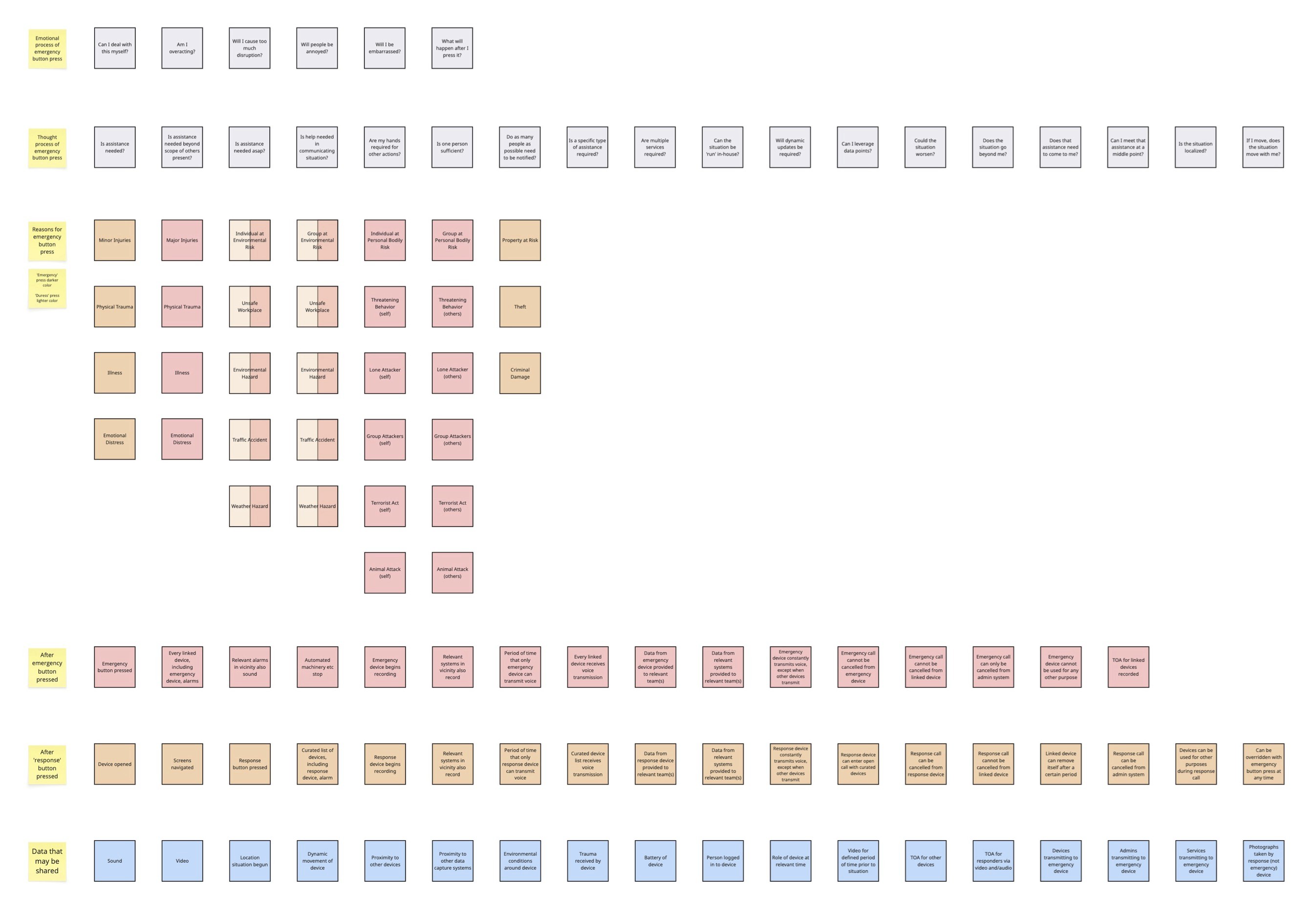
Duress mapped across:
Admin configuration
Trigger mechanism (physical, digital, drop detect)
Alert routing (PTT group, admin, other users)
Information surfaced (location, video, audio)
External integration (emergency services, hospital codes, CAD systems)
This revealed gaps between what products claimed to do and what they operationally enabled
The impact
The outcome was platform-level positioning of duress as an ecosystem capability, not a button feature.
Key insights included:
Visibility and Affordance Matter Under Stress
A panic button without clear visual and tactile distinction becomes unreliable in high-adrenaline scenarios.False Positives Create Cultural Risk
If accidental triggers occur frequently, alerts lose urgency and response behavior degrades.Alert Routing Is Inconsistent Across Modalities
Some solutions notify only PTT groups; others escalate to admins or external services. Configuration flexibility varies dramatically.Information Context Is Fragmented
Not all solutions transmit location, video, and audio simultaneously. Emergency responders may receive partial situational awareness.Hardware Alone Cannot Solve Duress
Battery life, signal dead zones, docking friction, and app authentication all affect emergency reliability.Cross-Service Communication Is Broken
Major incident response often fails due to inter-department communication limitations, not lack of hardware.
The work influenced:
Hardware case redesign discussions
Color and affordance reconsideration
Trigger modality prioritization (physical + digital + drop detect)
Alert routing flexibility requirements
Integration roadmap thinking (CAD, emergency services, hospital systems)
AI exploration for prioritization and emergency triage
In healthcare, this meant ensuring clinicians are protected during home visits and patient escalation scenarios. In policing, it meant acknowledging that officer safety is not about ruggedness alone, it is about reliable escalation, intelligent routing, and information clarity under pressure.