
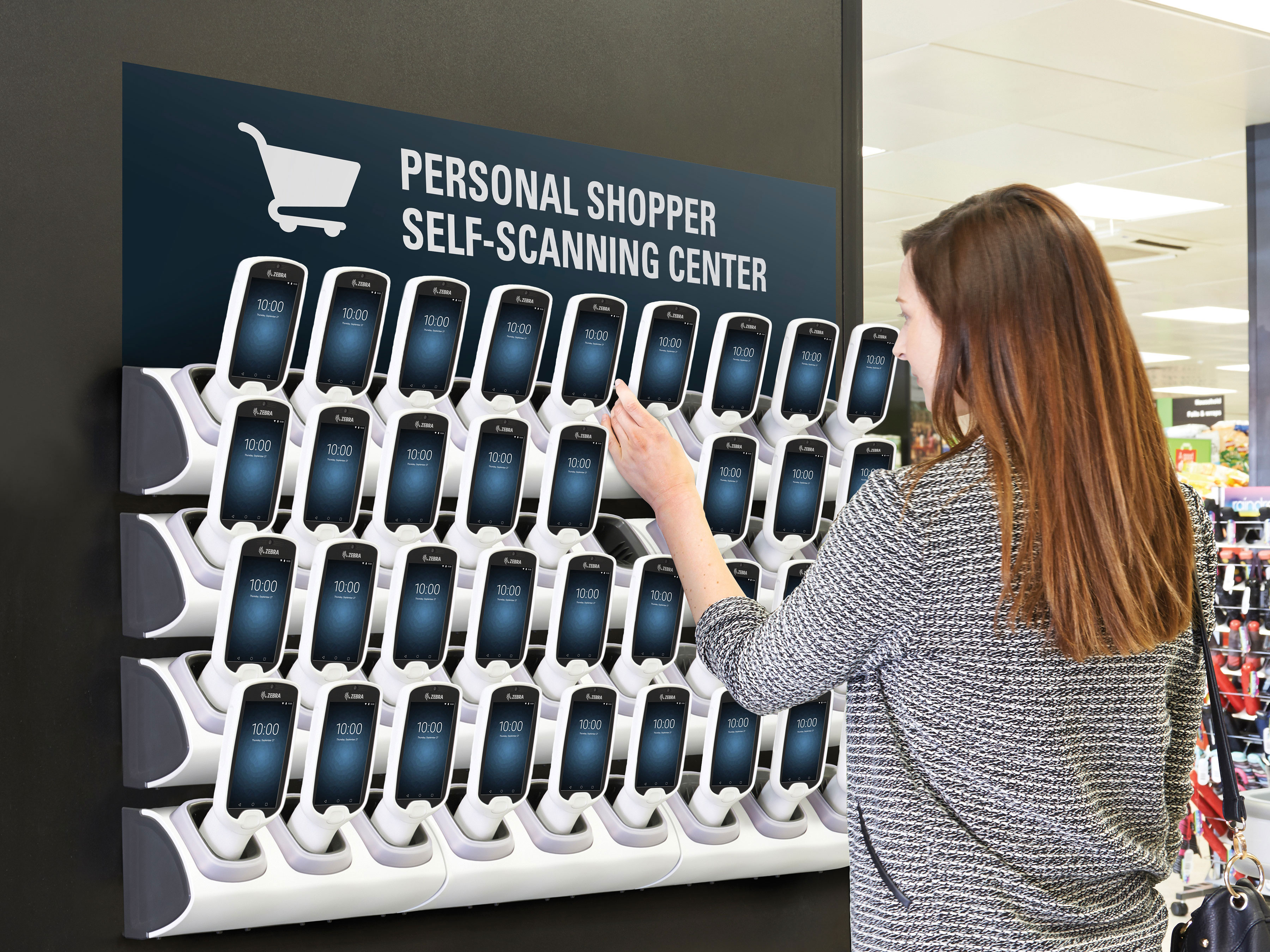
We needed hard evidence across markets before anyone could credibly set strategy. I led a large online study of grocery shoppers who had shopped in-store in the past four weeks, covering 877 surveys across Europe and North America with a deliberate emphasis on Europe due to stronger market penetration. The study spanned UK, Sweden, Netherlands, Italy, Germany, France, the United States, and Canada, and compared the Personal Shopping System against adjacent in-store technologies including self-checkout, smartphone self-checkout, and smart carts.
The challenge
Assumptions about shoppers were driving decisions. The real question was where PSS actually wins, and why?
We needed to answer whether PSS users were meaningfully different, what drives adoption, and how PSS performs relative to other solutions, especially by trip size and region. The sample included 404 PSS users (329 Europe, 75 North America) and 473 non-users (329 Europe, 144 North America), allowing direct comparison between segments and geographies. The goal wasn’t just “is it liked?” It was understanding loyalty, preference, friction, and positioning levers that could convert non-users.
My approach
Start broad, then cut the problem into decision ready comparisons. Every section was designed to remove ambiguity from a strategic choice.
I structured the research around strategic decision points: user profile differences, competitive comparison, drivers of trial, and the clearest pathways to conversion. I ensured the study separated usage (loyalty) from satisfaction, and both from preference under different shopping contexts (few items vs basket/cart). I synthesized the output into executive-friendly narrative slices that answered “so what?” Where to position PSS, where it is vulnerable, and what to improve first.
The study measured shopper behavior, attitudes, and technology adoption patterns, then compared PSS against self-checkout, smart carts, and smartphone self-checkout. I focused analysis on:
(1) Segment differences that matter for targeting
(2) Where preference flips by trip size
(3) Experience quality and friction points
(4) Messaging hooks that attract non-users
This approach surfaced not only what people say they like, but what they actually prefer in realistic shopping scenarios.
The impact
PSS isn't a universal winner, it's a context winner. This gave teams clear levers: who to target, how to position, and what to fix first.
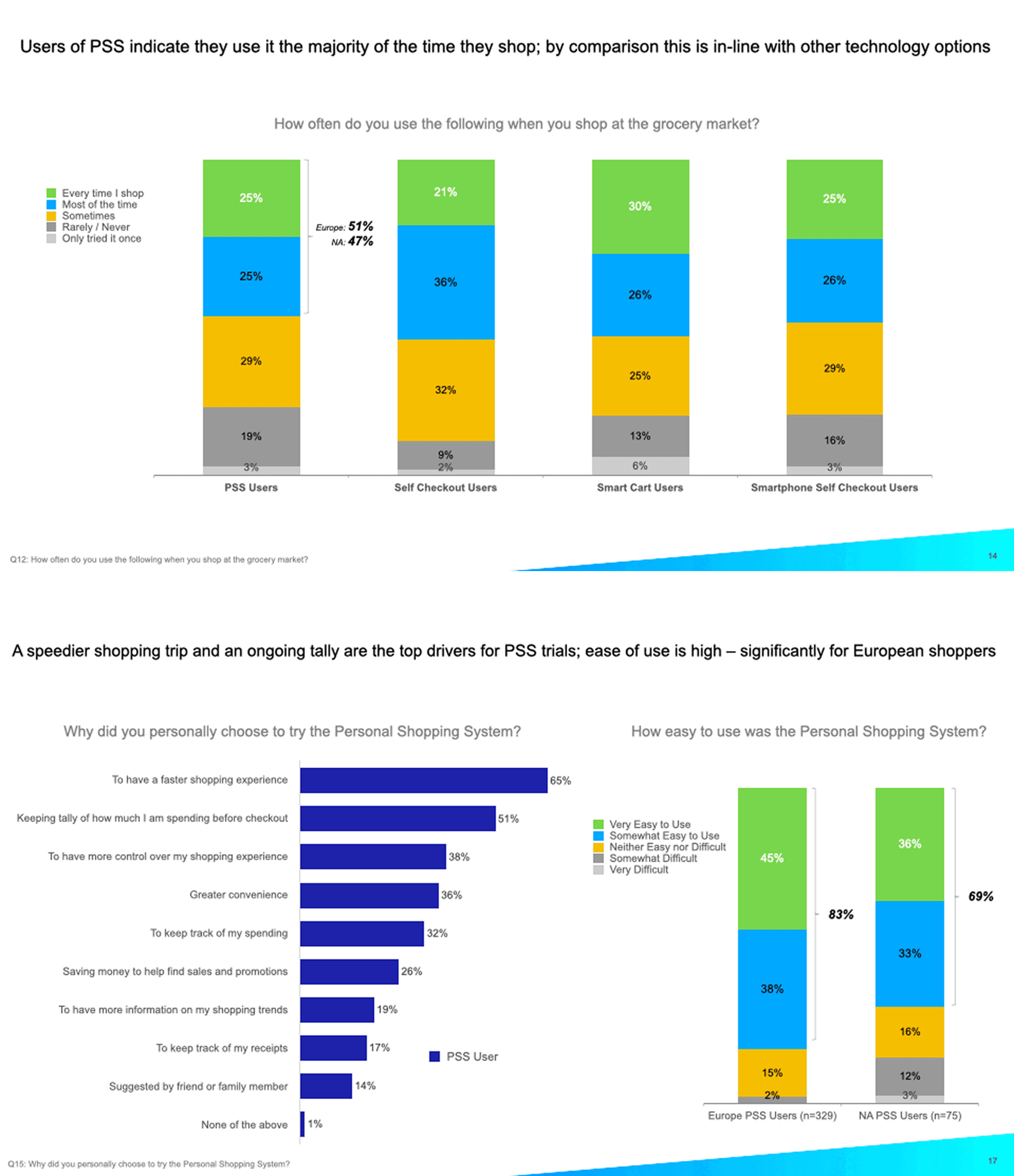
Preference shifts sharply by shop type: when shoppers have only a few items, self-checkout leads (67%) vs PSS (57%), but for a basket/cart full, PSS becomes the top choice (61%) vs self-checkout (55%). Satisfaction is strong but not uniquely dominant: 73% of PSS users are “very/somewhat satisfied” versus 80% for self-checkout (and 69% smart cart, 75% smartphone self-checkout). Europe shows stronger advocacy and ease: NPS 13 in Europe vs -5 in North America, with 39% promoters in Europe vs 32% in NA, and ease-of-use 83% Europe vs 69% NA. Importantly, friction is concentrated: only 37% report scanning issues, and the next biggest issues are unclean devices and availability (31% each). Actionable, operational fixes rather than a total experience failure.
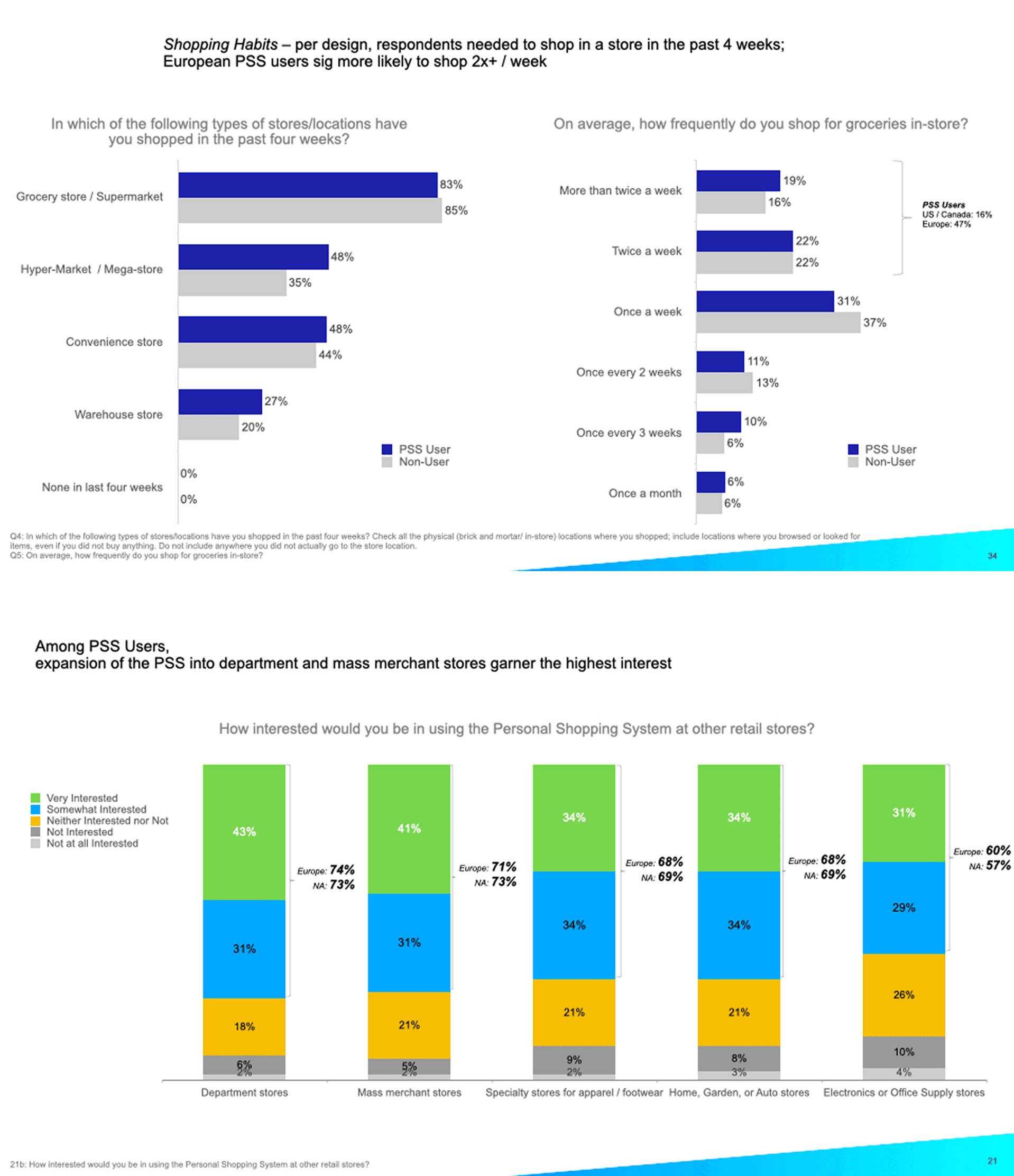
The findings produced a defensible positioning foundation tied to real motivations: the top reasons shoppers try PSS are speed (65%) and keeping a running spend tally (51%), with 36% citing convenience. For feature roadmap and messaging, interest clustered around high-value additions: promotions (74%) and payment (66%). For growth, non-users showed strong openness (particularly in Europe) where 49% of non-users are very/somewhat likely to use PSS if offered. Net: this research clarified where PSS should compete (bigger shops), where it’s vulnerable (small trips), and what operational issues most directly improve experience (scanning reliability, cleanliness, device availability).